Today, without a tool
- The decision is taken on instinct, or on the size of the estimate.
- The price is set to win, without knowing where the loss starts.
- Nobody knows this buyer pays at 180 days; the cash flow finds out later.
2/5 From the first notice to the last dirham collected
Bidding costs days of work. The question is not whether you can bid, but whether you gain by it.
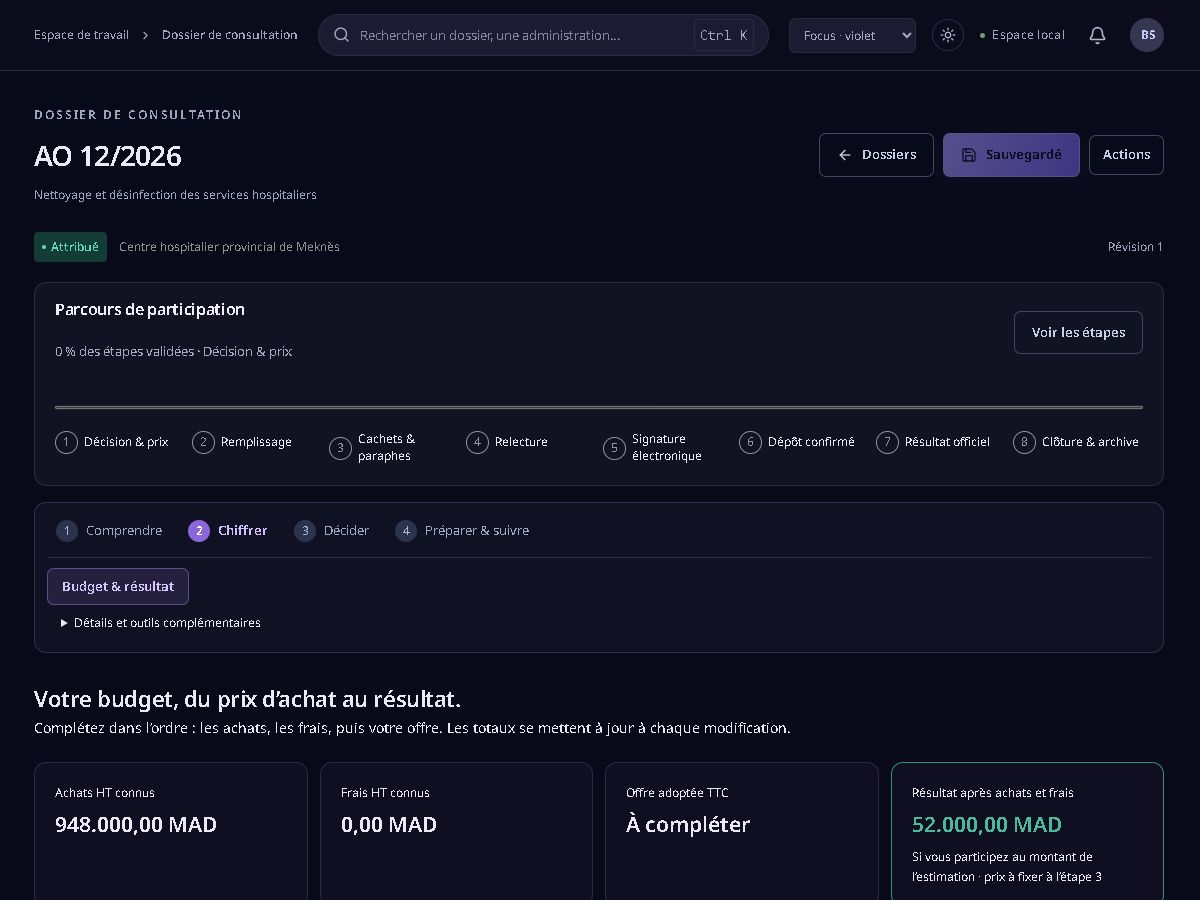
Every file shows the amount below which you lose money, purchases and overheads included.
The bill of quantities is imported line by line: purchase price, overheads, VAT and margin recompute as you type.
Closed contracts from the same buyer show where offers are accepted, and the gap with the estimate.
Win rate, observed payment delays and amounts outstanding with that administration.
Eight weighted criteria, one blocking criterion, and a reasoned decision the team finds again later.
No. It is decision support computed from published data. No administration refers to it.
Yes. The refusal is reasoned and kept: next year you will know why.
A contract does not end on submission day. That is when the money is won or lost.
A search that returns three hundred notices a week helps nobody. What matters is seeing the ten …
Bidding costs days of work. The question is not whether you can bid, but whether you gain by it.
A bid is rarely lost on price. It is lost on an expired certificate, a missing document or an ab…
This is where money is lost, months after the award, and where no tender-watch platform goes.
A contract executed is not a contract paid. Late interest exists — someone has to count it.